
Don’t ya just love it when you’re looking for an idea, or some information, or instructions, or opinions, or insights, or inspiration, so you type something into Google and find a result that’s helpful and/or entertaining?
Well the people who publish those blogs love it too, because they wanted more eyes on their brand. By sharing their expertise and experiences, they’ve created a web page that can appear in Google search results – which leads to more website visits, and ultimately, hopefully, more customers too.
But here’s the thing. AI. AI is the thing.
AI tools like ChatGPT allow businesses to generate and publish a tonne of free blog articles on their website in a fraction of the time and at almost zero cost – and they’re doing exactly that.
Instead of spending a few hours either writing or working with a copywriter, a whole heap of businesses and people are replacing these shared experiences and expertise with ChatGPT generated stuff.
Or, as I called it during my short interview on BBC Radio Bristol this morning, drivel and slop. And oh gosh I was pleased that my first BBC appearance as an adult gave me the opportunity to say drivel and slop.
Right now, we’re seeing an explosion in ChatGPT blogs dominating search results, and even crowding out the blogs of your favourite brands and businesses. But if you’re like me and like most blog readers, you just don’t wanna read any more of these generic, soulless posts.
79% of readers view brands that post AI-generated content less favourably
Last summer I popped out a survey to ask how readers felt about AI and ChatGPT content, with the aim of turning the results into a blog article. Well, because I’m a very unreliable real-life-human, I never got around to spending those hours writing it up or adding my own insights and expertise.
Here’s a link to the survey if you’re curious, and here were the main findings from 123 respondents:
- More than 85% of readers believe they can tell when an article was created using AI
- More than 85% of readers trust AI content less than human-written content (none trust AI more)
- More than 88% of readers believe brands post AI content primarily to save money on writing content
- If they found out that a brand whose content they loved was using AI to create all of their blog posts, 79% would view that brand less favourably
So basically, people don’t like ChatGPT content. They don’t wanna see it on websites, and they don’t want to read it.
ChatGPT content is also full of lies
And this is my biggest beef right now. ChatGPT is a generative text tool – which basically means it makes stuff up. A lot of the time, it makes stuff up based upon available information like other websites, and sometimes it makes stuff up because it’s just writing what the user expects to receive, or what the average user would accept.
Let’s take a look at the bio it wrote for my website design co, where I’ve highlighted everything that has never been said about Studio Cotton.
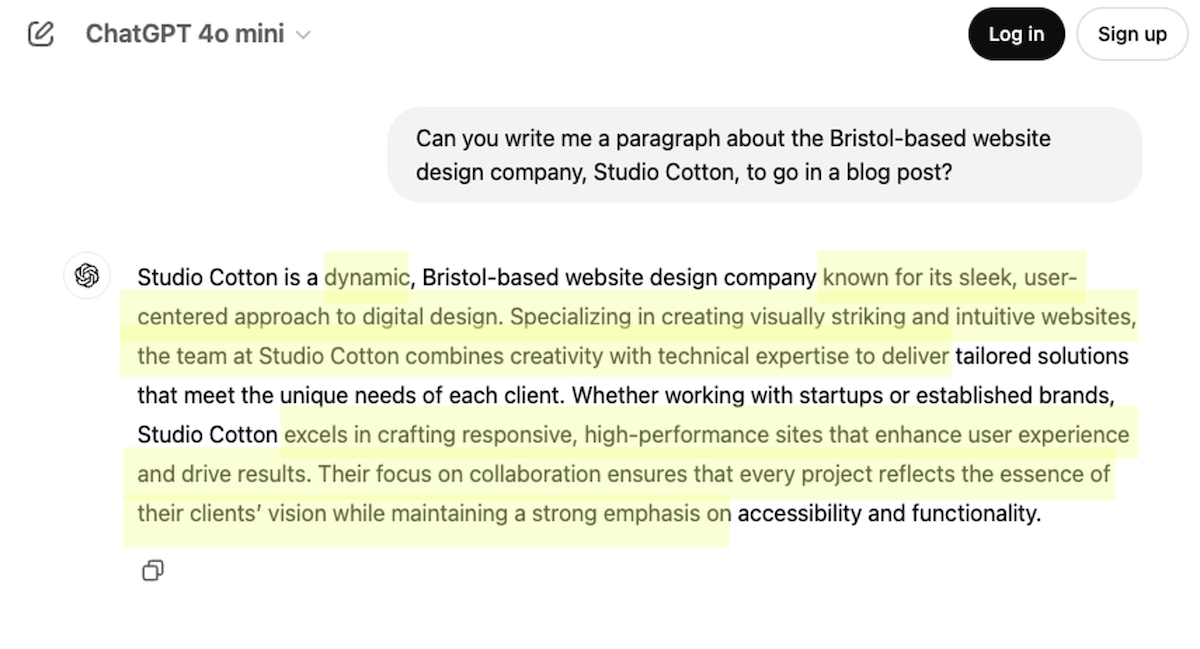
But it seems so real, right? The average reader wouldn’t be able to tell the difference between this and a genuine bio for my business that someone else might have included on their website.
While this bio that’s about a web design co but not my web design co, is relatively harmless – there are far more instances where AI can produce a dangerous output from bad business advice through to inaccurate safety and medical information.
The thing is, you’ll never know when something is totally made up by ChatGPT, or when it’s derrived from legimate sources – and until that day – ChatGPT is basically a misinformation machine. Funsies.
So let’s get to the meat of this article, and chat through 13 tell-tale signs that a blog was generated by ChatGPT, in case you wanna spend less time reading bot drivel-and-slop and more time finding info, inspo, and expertise from real humans.
Side note: none of these signs are a guarantee that a post was definitely generated by ChatGPT or any other AI tool, they’re more like a bunch of fat quarters that can be stitched together to create a tastefully quilted but alarming big red flag.
1. No declared blog author
If someone has spent an hour or 6 writing a blog article, or maybe 600+ hours writing articles for their own blog, or collaborated with (and paid) a ghost writer to help extract and format their expertise – they generally want to put their name on it.
It’s often a source of pride, but also accountability. Putting an author’s name against their blog allows any reader to look deeper and understand the source of someone’s expertise, experiences and point of view, and judge is their person has an authority worthy of trust.
However, in my experience, those posting ChatGPT blog posts tend to be more reluctant to put their name on it.
Anecdotally, I’ve heard reasons for this like not wanting the readers to know that the business doesn’t actually know if what they’ve posted is accurate, or that they just don’t feel comfortable having that personal association.
If you’ve just opened a blog post – especially from a person or business you’re not already familiar with – head straight to the header or sidebar and look for the name of the author.
2. Avoiding saying “I”, “you”, or “we” with the passive voice
The passive voice takes the person out of the writing, which is such an odd choice for blogging where readers expect to hear the opinions of the individual author. Now as a heads-up, I am not a professional wordswoman – if you are a professional wordenator then plz don’t be mad at me if my explanation is a lil off.
Here’s a couple of examples of active vs passive voice:
- Active: I highly recommend the sausage rolls from Gloucester Services
- Passive: The sausage rolls from Gloucester Services are highly recommended
- Active: I like to use emojis in my email subject lines to help them stand out in your inbox
- Passive: To help stand out in inboxes, emojis can be used in email subject lines
- Active: If you’d like to stop killing your calatheas…
- Passive: To prevent the killing of calatheas…
ChatGPT ruddy loves generating blog answers in the passive voice, even though on other occasions it’s more than happy to I I I all over the shop.
As a bonus thing, the passive voice is very handy when crafting emails about awkward topics when you don’t want the reader to feel like they’re being blamed for something, e.g.
- Active: Your website went down because someone clicked the button that says “DO NOT CLICK”
- Passive: The clicking of the “DO NOT CLICK” button resulted in the website outage
3. American English and incorrect regional dialects
Ello govnu, I’m Bri’ish and I love a bo’le o’ wa’er. I also love writing my blogs in British English because, well, I’m British, speak English, and my audience is also predominantly British. Not always English though, I like to think I’m pretty big in South Wales at least.
Anyway, a lot of businesses mass-generating low-quality ChatGPT blog content forget to switch over to their own local dialect. So, if you spot a post from a Brummie driveway company sharing “How to organize your parking lot asphalt restoration project”, it’s might just be ChatGPT, as it’s unlikely that a real human would overlook organise, car park, and tarmac.
4. The blog reads nothing like the brand or person sounds in other media
I’m a silly goose. I’m a silly goose here in my blog, and a silly goose when I share business tips on Instagram too.
I mean, I’m a silly goose who knows an absolute fucktonne about websites, SEO, UX, web accessbility, and small business stuff – I just write about it in a silly goose kinda way.
It’s really unusual for an individual person to present with totally different writing styles and practices between platforms. In my experience, a lot of writers tend to be a little more formal when blogging – but rarely so much that you question if it’s really them.
If you’re concerned that a blog post you’re reading wasn’t really written by a real human, head to the author’s social media profile or a recent podcast appearance, and try to find a clip of them speaking – this can often quickly reveal a cheeky ChatGPT substitute.
5. Perfectly spaced subheadings
Subheadings are a crucial component of a search-engine optimised and user-experience optimised blog. When used correctly – and usually appropriately marked as Heading 2 – they form part of an article’s hierarchy.
They basically say to Google “Here are the sections in this article, and this is what they’re about”, and they help readers to track where they are in a post so they can skip back-and-forth, or maybe even give a lil extra attention when they know they’re nearing the end of a post.
ChatGPT is an absolute babe at including appropriate subheadings. In fact, I shall go as far as to say that in general, this is an area where ChatGPT out-blogs the average blogger.
However, an extra quirk is ChatGPT-generated blogs tend to have almost perfectly spaced subheadings, like no human could so perfectly write the same amount in each section. Just compare this human-written section here to entry number 3 where I got to the point much more efficiently.
6. Awkward repetition with the Pyramidesque Syntax
For a bit of background that I originally popped into my intro and then cut out because I was going on too many tangents – blogging is generally bloomin’ brilliant for SEO.
I mentioned that blogging gets more eyes on a brand – but a lot of people are often surprised by just how many eyes. Pause for a second and guess how many times one of the articles from my website appeared in Google search results last year. I’m gonna just in a pic of a can of spam for you to scroll past to find the answer.
Now if you guessed 100,000 times – you would be totally wrong. It was actually just over 3 million times.
So what’s the Pyramidesque Syntax, you ask? Well, it’s a term I just coined for when a ChatGPT blog article follows this structure in its blog sections.
- Short subheading
- Slightly longer waffly sentence that expands on the subheading
- Slightly longer again waffly sentence that expands on the first sentence
With each string of text contained a bit more information than the one above it, creating a kinda word-based pyramid out of syntax.
Here’s an example, and also I just realised that we top all of our articles with “AI-free”, and I’ve been chucking in screenshots from ChatGPT. Soz.

Now, I don’t actually know much about pond maintenance, so I can’t comment on the accuracy of this advice.
What I can comment on is the classic use of the Pyramidesque Syntax structure. It’s not even that it’s particularly bad writing, it’s just sooooooooo ruddy common in ChatGPT blog posts.
I threw 5 different blog generation prompts into ChatGPT for this section, and each one contained multiple instances of the Pyramidesque Syntax.
7. Middle-of-the-road and surprise-free blogs
Sometimes when we’re searching online, we’re looking for extras and alternatives rather than answers.
Like if I’m looking for gifts for my garden-loving grandad, I have probably already thought of fancy trowel or those lil sticks people use to label their bean varieties.
When I Google “best gifts for gardeners”, I expect to find results that suggest trowels and sticks – but what I’m really searching for are the ideas I wouldn’t have come up with myself.
I’m looking to be surprised and enlightened by hearing directly from gardeners, and those who have previously pleased gardeners with their gifts.
I want Michelle McNicegarden to write about how much she loved it when her granddaughter bought her a floral A4 filing box from Paperchase to store the labels of spring flowering bulbs, so she could keep track of when they’d bloom.
But alas, because ChatGPT generates off the back of what already exists, it produces fundamentally average articles. It’s all trowels and sticks, and no floral filing boxes.
8. No external or internal links
An external link is a link from a website to another website. An internal link is a link from a website to a different page on the same website.
These links are generally considered ‘good for SEO’, so it’s odd that ChatGPT doesn’t include them when generating blog content.
Well, that’s because ChatGPT doesn’t know what other pages are on the website where this article will be published, and it’s currently pretty rubbish at knowing about individual pages on other websites too.
I personally find this extra-noticeable when you find a blog article that is product-focused – like gift ideas for grandad gardeners – but instead of actual products you can click through to and buy, instead you’ll find broad descriptions.
9. No personal opinions or experiences
Subjectivity makes blogs better. I’ve said it before, and I’ll say it a thousand more times. It’s a topic I’ve also hammered into our content producer Lyzi when I asked her to write 10 easy peasy ways to make small business blog content more subjective. Now those are some nice internal links right there.
The experiences, opinions, expertise, insights, icks, explanations and more of individual real people makes an article more compelling, and more likely to turn a reader into a fan or follower.
Pool ol’ ChatGPT doesn’t have those though, so the ol’ bot can’t add them into its AI-generated blog posts. ChatGPT hath no gardening grandad or gift-giving granddaughter, it hath no Lyzi to reference, and it hath not the creativity to create a silly goose term like Pyramidesque Syntax.
10. Stuff tagged on at the end of a section or blog post
Not everyone who uses ChatGPT to generate blogs will publish the content as-is. Some people will use the original output as a mere jumping off point, but a whole heap will just shove some of those in internal links and personal opinions at the end. Job’s a good mediocre ‘un.
You’ll be able to spot these tagged-on bits and bobs, as there will often be a switch in tone of voice, or it’ll jump from well-formatted, grammatically accurate prose into an all-lowercase, typo-laden list. It might also just not make total sense, like just shoving in a list of random products.
11. Impractical ideas and bad suggestions
What’s a good gift for podcasters? According to the 20+ ChatGPT articles I had to sift through not too long ago, I should get them a podcasting mic (which they’d already have, and probably have a preferred model), a chair (which they’d already have), and podcasting software which THEY’D ALREADY HAVE AND NOBODY WANTS SOFTWARE AS A GIFT.
When ChatGPT is generating blogs it doesn’t care if the output is actually good, it only cares if the user (the person putting in the prompt) will accept the answer. Well, actually, it doesn’t care about anything, for it isn’t a human.
Anyway.
ChatGPT blog posts tend to contain a lot of these bad ideas, but they often don’t stand out until the reader really dwells on it.
12. No photos or very very very loosely related stock photos
This is a fun one. ChatGPT can’t generate its own images to pop in its blog posts, and that’s coming from the robohorse’s mouth.
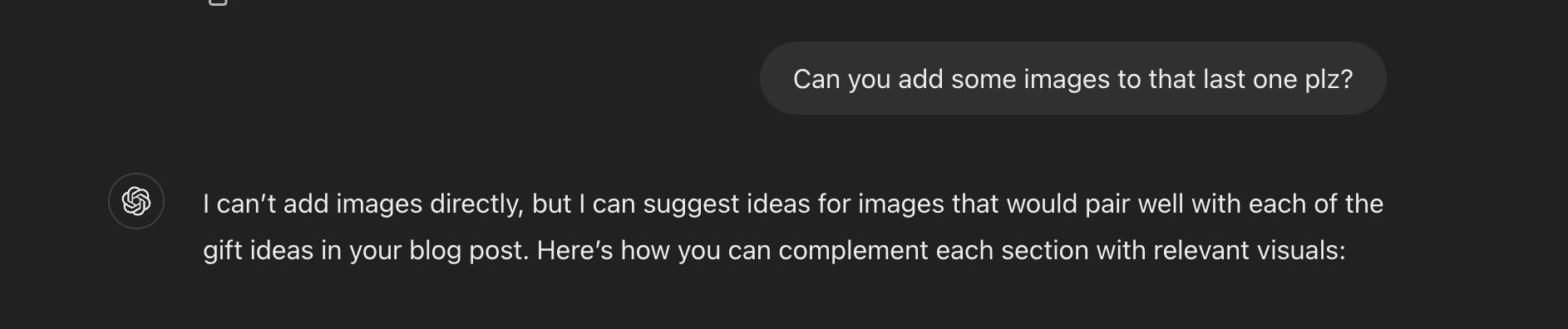
However, images are generally pretty good at keeping readers engaged with blog content, and at the very least, each article needs a featured image which appears at the top of the page.
So a lot of website managers and SEO peeps wanna chuck a couple in, and the easiest way to do that is to grab some stock pics from a stock photography website.
These stock photos are often not directly related to the content, they don’t fit in with the branding of the blog website, and they almost never match each other. They might even be credited to popular stock libraries like iStock, Getty, Unsplash or Pexels.
13. They’re so. Fluffin. Boring.
The detached style of ChatGPT content fits somewhere between the dullest of academic papers and blandest of corporate word vom. It’s just not great to read, and might struggle to keep you engaged.
If you’re left thinking “why did I bother to read that?”, well, it might be that the person who published it didn’t even bother to read it.
So those are my 13 tell-tale signs that ChatGPT generated that blog post that bored your pantaloons off. I’m already thinking of more signs I could add in, but this post is long enough and I wanna stop writing and go home.
If you wanna write content that doesn’t sound like a sad bland robot but still increases you’re website traffic, girrrrl are you in luck. We’ve got a whole tonne of articles on website SEO and blogging for business, as well as 56 seasons, occasions, & times for your UK blog and content planning.
Until next time, have a ruddy lovely day you silly goose.