
I’ve been writing helpful website articles on this Studio Cotton blog since 2016, and despite publishing more than 30 articles on SEO alone*, I’ve never written up some go-to website tips for improving your local SEO. Shame. On. Me.
So that’s what we’re gonna do today, I just need to set the scene first.
What is local SEO?
SEO is the process of optimising a website and content to get more traffic from search engines, hence the name Search Engine Optimisation. For each search engine, there’s basically a different ‘type’ of SEO.
With Instagram SEO, you’re trying to please Instagram’s algorithm so your posts appear in more feeds. With Etsy SEO, you’re trying to please the Etsy search bar so your products appear for more searches. These days you might even be hearing about AI SEO (which might also be called GEO), which is all about optimising to appear in generative AI/ChatGPT results.
And then there’s bog standard SEO, which is essentially optimising your website for Google searches.
So what’s local SEO? “Local” ain’t a search engine, so how do we optimise for it?
Well, this is where local SEO is a bit of a pesky sausage because it’s not one of those different types of SEO, it’s that bog standard Google SEO – with a different goal.
Local SEO is a sorta subset of SEO, with the specific goal of ranking as highly and as often as possible with people in a specific geographic area.
How important is local SEO?
It depends.
Gosh don’t you hate that answer? I know I do. Well, the excellent news is that I’m going to tell you what that depends on.
It depends on how important location is to your audience and your business. The higher the importance of location, the more effort I recommend putting in to your local SEO.
A Brummie plasterer who pretty much only works in Birmingham? Local SEO is mega important.
A company that sells aesthetic computer mice? Local SEO is nice, but not essential.
However, local SEO is never bad, and it is unlikely to ever have any negative consequences.
So if you’re based in Newcastle but sell worldwide, local SEO won’t make it harder to reach people in Yeovil. It will help you attract additional Geordies and maybe some Mackems who wouldn’t have known about you otherwise.
1. Set up Google Business (if you can)
Google Business is the service that creates those big sidebars in your search results, and populate listings in Google Maps. It can be a proper fiddler to set up, and I’ve met more business owners who have struggled to get Google Business running than I could possibly count.
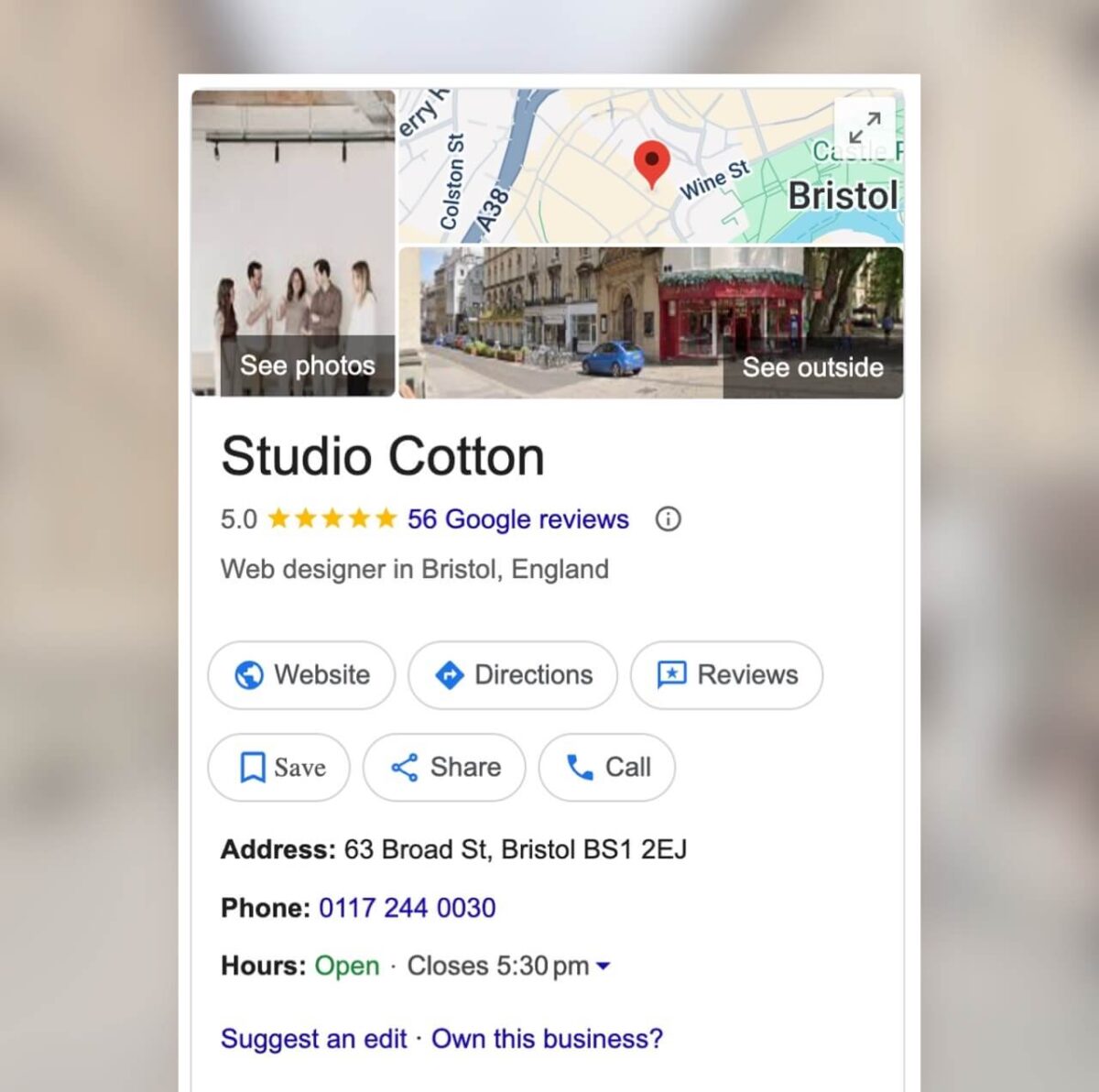
Google Business – particularly the map view – can be incredibly important for any businesses with physical locations that are open to the public.
Just think of all the tourists who do exactly what I do as soon as they get off the train in an unfamiliar City – search “Coffee”, “Open Now”, “Top rated”.
However, I’m gonna poop on Google Business just a little here with my own anecdote, because I do generally only hear good things about why you MUST sign up and put all your eggs in this basket.
My website design co, Studio Cotton, ranks really well in Google Maps searches. I had no idea people would search a map for a web designer, but they do. In a Google Map search, you might have noticed that the “Call” button is just as prominent as the “Website” button.
Well, this has resulted in a fair few calls from enquirers who don’t really know what we do, our style, our technical capabilities, our pricing – all information that’s readily available on our website.
Whilst that’s not the end of the world, it does mean quite a fair amount of time has been spent on the phone with nice people who would’ve known with one click that we’re not who they’re looking for, rather than some 15-minute calls.
Anywho, if you need help setting up your Google Business profile, head on over to Google Business Profile.
2. Pop “Proudly based in Bristol” in your website footer
Just remember to replace “Bristol” with The Cotswolds, or NYC, or Slough, or Fiji, or wherever you are.
This tiny website addition takes a few minutes and is the easiest local SEO win out there.
Your website footer is on every single gosh darn page on your website, so adding in a very short location-based sentence means that Google can’t possibly miss where you are.
Not only does this help your local SEO, but it can also make your business appear more legit, and even more cool. Imagine landing on a website selling aesthetic computer mice that you’ve never heard of before, but you spot in their footer something like “Designed in Williamsburg, Brooklyn since 2021”.
Well, a scam company wouldn’t say that, and also – Williamsburg? I’m pretty darn sure that means this business is cool because if transatlantic pop culture has taught me anything, it’s that Williamsburg is cool.
3. Treat your location as an SEO keyword
SEO keywords are terms that are so essential to your brand, that if you missed one of them, your audience (and Google) would get a much less full picture of who you are and what you sell.
And yet – even though location is a pretty essential nugget of info about your business – it’s almost always missed off of brands’ SEO keyword lists.
My theory is that this is because a lot of SEO keyword tools won’t include local terms unless prompted to do so, which is also one of the reasons why I shared Why I loath SEO keyword tools on Instagram (yep, that typo kills me too).
SEO keywords should be used throughout your website – every page, every paragraph, every post. Before you hit publish on your next edit or addition, just see if you can pop your location into your content once or twice more.
4. Include your location on every service sales page
A service sales page is a page on your website that sells a service. Like a product page on an ecommerce website, but, well, a service on a service website.
An essential page section that I always always recommend, is an “About me/us” overview which means that your reader doesn’t need to leave your sales page to find out who you are.

I want you to do the same, and I would love for you to make sure that abouty section includes your location.
5. Include your location within every product description
Hey product seller, when was the last time you checked Google Analytics to find out how many of your product page visitors were new to your brand? Never? I get it. Google Analytics 4 does suck big apples.
Anyway. For a lot of ecommerce websites, their product pages are most frequently landed on by new users – people who have never visited that website before, and probably have never even heard your name before.
That’s why I want every single product description to include a little “About [my brand name]” section, and in that section – you guessed it – your location.
I like to write things like “All handmade from our independent ceramics studio in South Wales”, or “Find the full range in our small shop in Ilminster, Somerset”, or even a lighthearted and self-aware “Designed in London, made in Portugal, shipped from our storage unit in glamorous Slough.”
6. Create a location-based page, but only if you can really justify it
Eugh, location pages. I hate them. I hate most of them.
Just in case you haven’t come across this local SEO-bait that gives me the rage, most location-based pages are totally and utterly pointless pages of nothingness that have been created with the sole purpose of appearing for location-based search terms.
For example, you Google a term like “Interior design Surrey” and come across an independent designer that has a website page covered in Guildfords, Leatherheads, Wokings, and Goldalmings – only to find out that they’re actually based in Kettering.
And actually, if you read the page – it definitely feels like some AI slop that has just had a find-and-replace to swap out different towns and suburbs.
Well, it probably is.
These location-based pages are a proper old-hat, naughty SEO technique that worked really well for a while, and then stopped working because Google knows that they’re crap and nobody wants them, and now they work again because AI made it too easy to produce a million of them.
EUGH.
Anyway. ANYWAY.
My predication is that Google will once again figure out how to cleanse its results of these pages of location-based nothingness, so even putting the ethical/digital pollution/responsible consumption concerns to one side – I doubt they’ll be worthwhile in the longterm.
But.
If you do have a legitimate needs for location based pages, they can help your SEO. Think a café with multiple branches and different facilities and opening hours, or maybe a chain of car garages that have different equipment and services per site.
All other location pages can get dans la poubelle.
7. Break down your locations into suburbs, neighbourhoods, regions, counties, countries
Local isn’t one place.
I’m based in Bristol, which is in the West Country region, within the South West of England, which is part of the UK. It’s on the borders of Gloucestershire and Somerset, a stone’s throw from the Mendips and the Cotswolds, a 10-minute train ride from our much more famous neighbour Bath, and a slightly further train ride from our often chastised neighbour, Weston-super-Mare.
I also live in Bedminster, right next to Windmill Hill, but not in Southville where all the Londoners moved during the pandemic which is a very local, very sore spot.
This was all to say that when you’re thinking about your local SEO, it’s defo a good idea to have a focus location like Bristol or the Lake District – but it’s important to remember to expand into different local terms when you can.
It expands your local footprint, and gives you opportunities to appear in more searches, like when your next customer is looking for a plasterer in Sutton Coldfield, not just Birmingham.
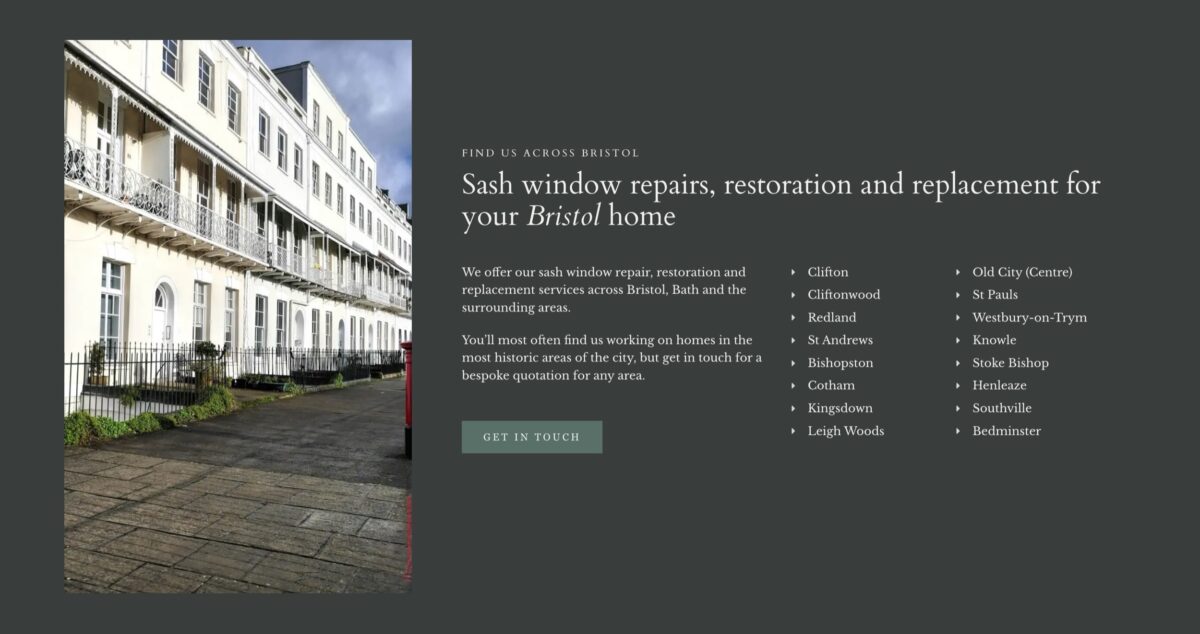
One of my favourite examples where we’ve put this into place is a website for Bristolian sash window repair company, New Life Sash. When creating their list of service areas, I literally opened Google maps and dropped the little yellow fella into various neighbourhoods that I reckoned would have posh sash windows. If I could see a sash, they went on the list.
Bonus thing: your country is a great local SEO keyword that’s way too often overlooked. After all, I bet even you’ve added “UK” to the end of at least one of your previous searches to try to find products you could actually buy.
8. Call out local landmarks and transport hubs
“Design shops near Tate Modern”, “Farm shops off the A30 Devon”, “coffee shop by Chelsea Flower Show”, “breakfast near Bristol Temple Meads train”.
If you want to massively increase your chances of appearing for these sorta searches, you need to write this sorta stuff on your website:
- Visit our independent design store in Southwark, located 5 minutes on foot from Southward station and less than 10 minutes from both Tate Modern and Southbank.
- You can find our farm shop just off the A30 between Okehampton, Devon and Launceston, Cornwall. No more sad motorway services, we’re the perfect pitstop to stock up on fruit, veg, basics and sweet treats for your summer holiday!
- 2 minutes from Royal Hospital Chelsea, home of RHS Chelsea Flower Show
- Looking for breakfast near Bristol Template Meads? Commuters, we got you. Find our cafe tucked away just behind the train station and start your day with the best coffee you’ll drink all week.
And here’s another example from one of our Studio Cotton websites, local landmarks on the Visit the Store page for independent Derbyshire gift shop, Handmade Design.
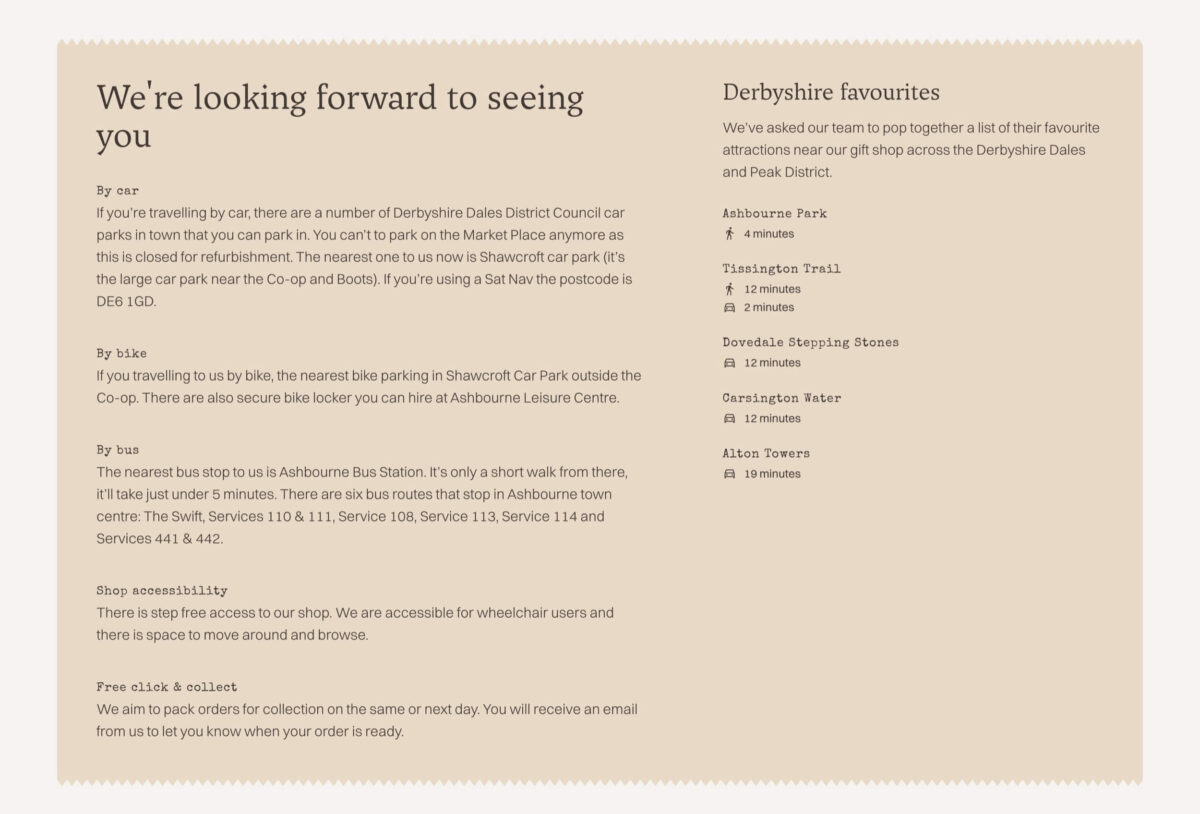
9. Write blog articles with a local focus
Creating blog content with a local focus is one of the easiest and most reliable ways to add a lot of breadth and depth to your local SEO, especially if you don’t really have a decent need to get local otherwise.
Like how our website design services aren’t specifically Bristolian. I mean, we do love to work with Bristolian businesses as much as possible, but our services work just as well with clients based in Devon and London and Glasgow and Carlisle and Toronto and New Orleans.
I can’t really add a suburbs breakdown because it wouldn’t be useful to my readers, and whilst we have written a local Bristol visitor guide, it’s not emphasised as we only really send it to people who are visiting the studio for an event or meeting.
That means if I want to add a lot more Bristolian stuff to our website and raise our local SEO profile, blogging is our best bet.
And that’s why we’ve published:
- 15 cool cafés and coffee shops for client meetings in Bristol
- 8 of our favourite events in Bristol for small businesses and freelancers (and one in Cardiff)
- 10 brilliant content creation spaces in Bristol
- 15 favourite Bristol arts organisations (and how to support them)
- 5 local Bristol bloggers who love collaborating with small businesses
- The 5 best creative workshop venues in Bristol
We still want to make sure your local blog articles make sense coming from your business, so think about other places, brands, landmarks and more that your customers would love to hear about from you.
10. Work on your local PR and SEO backlinks
What’s even better than you telling Google that you’re the best in your area at doing what you do? Other people telling Google, too.
A backlink is a link from any other website to your website, and each one acts as a little stamp of approval that also adds some context to your website.
So if you have a stationery shop in Cardiff that gets featured in a Wales-based blog in an article called “the 12 best independent shops in Cardiff”, well that really helps Google to understand that your shop is relevant to people who love shopping and Cardiff.
Outside of press and publication features, there’s also collaborations with other local businesses, events & talks, sponsorship and more.
Alas, I am no PR expert – so if you wanna check out more PR people, here’s some total legends:
I’ll also give a shoutout to Pippa of the The PR Set’s appearance on the Building your Brand podcast with Liz Mosley, as I really enjoyed listening to this episode whilst performing my summer pond maintenance.
Oh, and if you wanna know more about SEO backlinks – I got more blogs of ours for ya too:
- SEO backlinks for beginners: Why? Where? How?! Please?!!!
- 7 simple and free SEO backlink building tips using only your existing contacts and relationships
- What makes for a good, quality SEO backlink? Here are 9 things to look for…
11. Pop locations on your customer testimonials
I started with a cheeky, small local SEO win – and I’m going to end with one too. When you include reviews on testimonials on your website, instead of just including…
“Studio Cotton are just the best people at making small business and podcast websites ever and founder Aime has great hair”
Sally McBusiness, Founder of McBusiness Co
Try….
“Studio Cotton are just the best people at making small business and podcast websites ever and founder Aime has great hair”
Sally McBusiness, Founder of McBusiness Co, London
This is such a small change that can make a significant difference to the quantity of local mentions on your website, and I’m going to end with another example from my own website, and the page promoting our private Slack community.
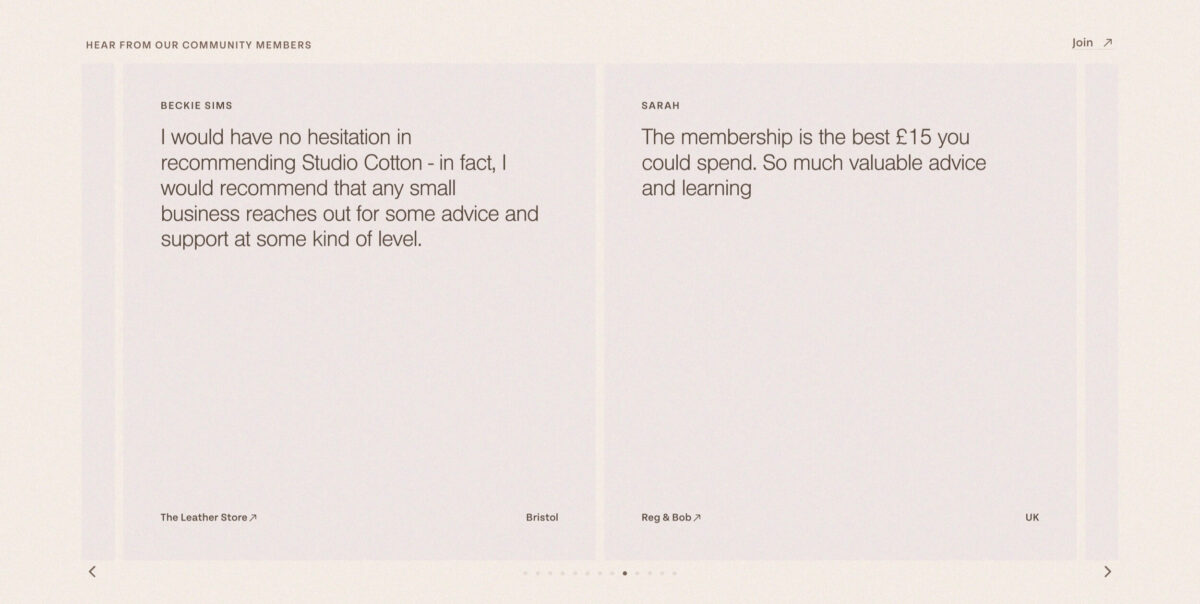
And that’s my 11 local SEO website tips for beginners (for businesses). I hope you’ve enjoyed this rundown and can start implementing a few (or a tonne) of these website tips for your own business.
If you wanna keep expanding your reach-growing know-how, check out our other blogs about SEO – or if you fancy something a little lighter, follow @studio.cotton where I share bitesize website advice for businesses and podcasters. Later, Quaids.